
Many of you have reached out to me with your curious parts wanting to find a seamless integration between A Course in Miracles (ACIM) and Internal Family Systems (IFS). I hear those parts! I also hear the parts that are wary of getting lost in intellectual complexity. All the parts expressing their excitement and concerns are equally wise, valid and welcome.
As you likely know, I have been commissioned to write a book on IFS and ACIM. With over ten years of studying ACIM, five years of teaching it, and my work as a Level 3 certified IFS counsellor, I’ve spent considerable time exploring where these two paths intersect. I am gradually laying down the wisdom I’ve gained, allowing Spirit to guide the process. In the meantime, while the book is still unfolding on the breath of presence, I wanted to offer this brief guide to support you now.
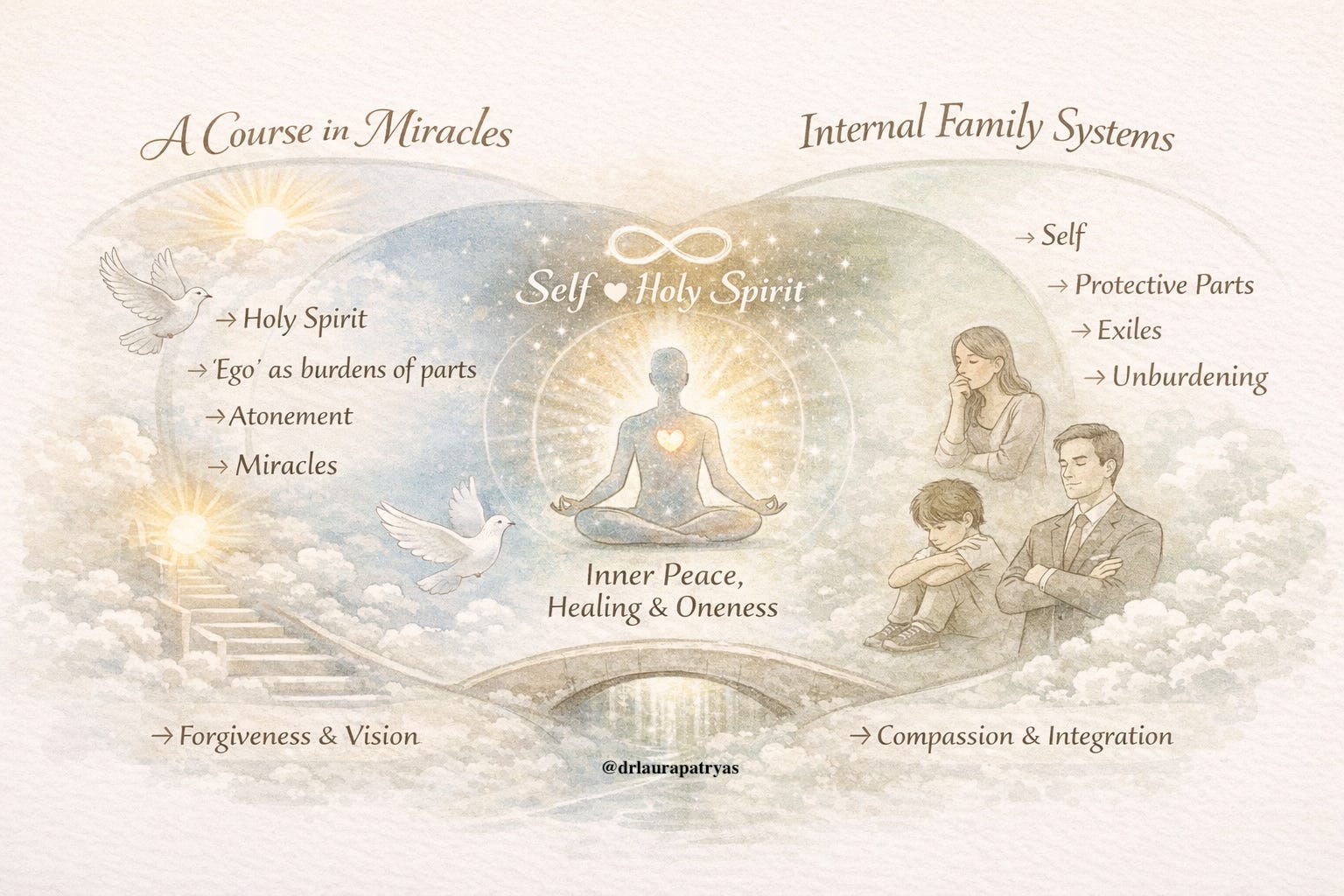
ACIM and IFS are ultimately oriented toward the same aim: peace, inner harmony and unconditional love. But they speak different languages. This is true of so many psycho-spiritual frameworks and sacred texts. The pointers vary vastly, but what they are pointing toward is one and the same.
It brings to mind the Buddhist teaching of the finger pointing to the moon. It’s as if ACIM points with one finger and IFS with another, yet they both direct our gaze toward the same moon. However, the Course’s direct language can feel invalidating or even threatening to our internal system. But that needn’t be so…

To bridge the gap between the two approaches, we can lean into playfulness, gentleness and a pinch of salt (or Self). Below, I offer some ideas for translating the languages of ACIM and IFS to reduce friction and deepen our practice.
Where friction commonly arises
1. The “ego” problem
This is usually the biggest sticking point.
In ACIM, the ego is described as a false thought system based on separation, fear and guilt, which needs to be forgiven and gently undone (reinterpreted) by the mind. The goal is to recognize the ego’s illusions as harmless mistakes, revealing our true nature. More playfully, it is the thought system (or the idea) we forgot to laugh at, instead we took it seriously.
Into eternity, where all is one, there crept a tiny, mad idea at which the Son of God remembered not to laugh. In his forgetting did the thought become a serious idea, and possible of both accomplishment and real effects. The instant that the madness of the cause is recognized, it can have no effects. Together we can laugh them both away, and understand that time cannot intrude upon eternity. It is a joke to think that time can come to circumvent eternity, which means there is no time. [CE T-27.X.6:1-5]
In IFS, our parts (often associated with the ego) are sacred, intelligent and protective. They help us survive, are natural and valuable, and are shaped by our history. The burdens they carry, however, can block access to Self energy (the inherent, loving essence) beneath the burdens.
One way to reconcile the two perspectives is to see that when ACIM speaks of the ego, it is referring to the burdens our parts carry, not the parts themselves. The Course does not ask us to get rid of our parts, but to release the belief in separation from Self that they have been forced to carry. The Holy Spirit (Self), therefore, does not attack, shame or deny parts but rather gently unravels the burdens they carry.
2. The language of “God”
Words like ‘God’, ‘Holy Spirit’, ‘He’ and ‘Brother’ can activate parts that hold religious or spiritual trauma, sensitivity to hierarchy or patriarchy, and fear of dogma, authority or coercion.
Noticing these reactions can be genuinely useful. They often point to important protectors asking to be heard. When they are bypassed, spiritual work can slip into a form of dissociation. Taking time to acknowledge and gently unburden these parts can help the entire journey feel safer, more grounded and more spacious.
3. The language of “sin”
The word sin can be activating for many people.
In ACIM, sin does not mean moral wrongdoing or something that deserves punishment. It refers to a mistaken belief in separation, a perceptual error rather than a real transgression. The Course is clear that sin is not real in truth and has no actual effects beyond those we imagine.
In IFS terms, sin maps to the core burdens carried by parts, particularly parts that hold shame, badness or the belief that something is fundamentally wrong with them. These burdens are not evidence of failure, but adaptive responses to pain, neglect or trauma.
When ACIM says sin must be undone or forgiven, it is not calling for self-judgment. It is pointing toward the release of these burdens through gentle recognition that they were never who we truly are. Seen this way, undoing sin aligns closely with the IFS process of unburdening and restoring parts to their natural innocence.
If like me, you have etymology-loving parts, here’s a quote from Awaken to Love regarding the meaning of the sword sin:
This might necessitate a shift in perspective and a move away from the
moralistic and judgmental connotations often associated with the term "sin."
The word "sin" in English is translated from the Greek hamartia, which
means "to miss the mark." Similarly, in Latin, the verb peccare means "to
stumble, to trip, to falter," while in Hebrew, the verb kheit also has the basic
meaning of "to miss the mark." In Aramaic, the word sin is an archery term
that, again, means "off the mark, missed bull's eye."
As these words were translated into various languages, the meaning of sin
shifted to become associated with evil, diverging from its original intent.
Rather than being about inherent badness or shame, sin can be seen as an
invitation to try again, to make a U-turn and reconnect with our true Self.
Noticing when we fall short of the mark is not a cause for shame, but an
opportunity to realign ourselves and take another shot under the leadership
of Self.
4. Forgiveness
Forgiveness is central to ACIM and also one of the most misunderstood teachings, particularly for people with trauma histories.
In the Course, forgiveness does not mean excusing harmful behaviour, denying pain or pretending that abuse did not matter. It is a shift in perception. From the IFS perspective, parts that have been harmed may react strongly to the idea of forgiveness, especially if it sounds like a demand to forgive abusers prematurely. These parts likely carry anger, grief, terror or rage that have never been acknowledged or witnessed. Asking them to forgive too soon (or at all) can feel profoundly wrong, not because they resist healing but because they are protecting the truth of what happened.
In IFS, forgiveness cannot precede witnessing. Exiles need their pain to be seen, named and validated by Self before any release is possible. If forgiveness is required before harm is acknowledged, it becomes another form of silencing or abandonment.
When properly understood, ACIM forgiveness and IFS unburdening align beautifully. Forgiveness is not something parts are forced to do but rather what naturally arises when burdens are released and the system no longer needs blame for protection. Forgiveness happens after safety, not instead of it.
5. “This world is not real”
In the Course, “the world is not real” does not mean that our experiences, emotions or suffering are meaningless. It means that the world we perceive is shaped by the mind’s belief in separation. The world is real as an experience, but not ultimate or fixed in the way the ego believes.
For many parts (especially younger ones) this language can feel terrifying. They may hear it as “my pain doesn’t matter”, “nothing is safe” or “I might disappear.” These responses are understandable and protective.
A helpful IFS-informed translation is that the meaning we give the world is largely parts-led and always changing. Perspective (one of the Ps of Self) can help us make a healing shift towards Self-leadership. From this view, the world becomes a classroom rather than a prison, exactly as ACIM teaches. Life does not disappear but rather becomes a place where Self can meet parts from a wider perspective.
6. “I am not a body”
This statement can be deeply unsettling, particularly for parts that associate the body with survival, safety or identity. In ACIM “I am not a body” does not mean the body is bad, unreal in a dismissive sense or something to escape. The Course is pointing to a shift in identity from identifying as only the body to recognizing the body as a neutral communication device within infinite consciousness.
For traumatized parts, however, the body may be where pain was endured or stored. Hearing “I am not a body” can feel like erasure or abandonment. These reactions are wise and protective. An IFS-informed translation is: I am more than my body. The body is part of experience, not the source of identity. When Self leads, the body often becomes safer, more regulated and more alive. ACIM is not inviting disembodiment, but freedom from the belief that the body defines or limits who we are.
Get curious about which part of you is ‘doing’ the Course
What feels important to say again is that our reactions to the language can be genuinely useful. They invite curiosity toward the protectors that are asking to be heard. When these reactions are bypassed, spiritual work can become a form of dissociation. Taking some time to acknowledge and unburden these parts can help the entire journey feel safer and more spacious.
Whenever students approach me wanting to do the Course, I always ask: Which part of you had this idea and what are that part’s intentions? It is very common for protectors to try to “do” ACIM.
As you read the lessons and practice them, you’ll likely notice different parts blending with you along the way. You might recognize:
a striving manager that tries to do the lessons perfectly without missing a day
a skeptical protector that argues with the metaphysics or logic
a spiritual achiever that wants the big shift or enlightenment now
young, vulnerable parts that panic or feel confused when reading statements like “This world is not real” because their pain feels very real
None of these parts are wrong. They are doing their jobs. If you have access to an IFS therapist, you might bring whatever parts arise during the lessons into therapy and see if it’s possible to get curious about them. Ultimately, the invitation is to allow Self to lead the lessons, gently healing and unburdening parts as you go.
How to let Self lead
So, the most important thing is not to force any part to agree with the lesson. In fact, the point is that you notice where parts disagree and simply remain present and open. If the lesson says “I am not a body. I am free” and a part cries out “but I hurt!”, simply pause. Turn toward the part and, from Self-energy, say something like “I hear you. Of course this feels scary. Your pain matters. You don’t have to believe this. Let me just hold this idea gently for a moment.”
This is not a failure of the lesson or our parts but rather the work itself. In this way, ACIM lessons become a powerful form of therapy, activating parts that are asking for attention, reassurance and healing.
Terminology translation
Ego
ACIM: The thought system of separation, fear and false identity; the belief that we are separate from God (SELF) and from each other.
IFS: The burdened state of parts, operating from beliefs of separation, unworthiness or danger (not the parts themselves).
Holy Spirit
ACIM: The inner teacher and voice for God that corrects perception and gently leads the mind back to truth.
IFS: Self energy as compassionate inner guidance; the aspect of awareness that helps parts unburden without judgment.
Decision Maker
ACIM: The neutral capacity of the mind that chooses between the ego’s thought system and the Holy Spirit’s.
IFS: Self as particle has the ability to navigate the system towards wholeness, however it can also become obscured by blended burdened parts.
Miracle
ACIM: A correction in perception that shifts the mind from fear to love.
IFS: An unburdening or reorganization of the system that occurs when Self is present and parts release fear-based beliefs.
Forgiveness
ACIM: The release of judgment and misperception, allowing us to be free.
IFS: Unblending from parts and facilitating the release of the burdens they carry (e.g. blame, shame and fear).
Atonement
ACIM: The undoing of the belief in separation and the acceptance of our shared innocence.
IFS: Remembering wholeness through restored Self-leadership and an internally harmonized system.
Illusion
ACIM: Anything perceived through the wounded ego; a miscreation based on fear rather than truth.
IFS: Protective narratives and beliefs formed around trauma that once served survival but no longer reflect present reality.
Salvation
ACIM: Awakening from the dream of separation into peace, love and unity.
IFS: A Self-led internal system characterized by harmony, trust and compassion among parts.
God
ACIM: Perfect, formless Love; the Source of all.
IFS: Universal SELF or unconditional loving awareness from which individual (not separate) Self-energy arises.
Perception/Perspective
ACIM: The way the mind interprets experience; either ego-based or Spirit-corrected.
IFS: The lens through which parts experience reality; when burdened, perception is fear-based, and when Self-led, it is spacious and clear.
Mind
ACIM: The level of awareness where choice, perception and awakening occur.
IFS: The entire internal system (parts, Self and the field of awareness in which they arise).
Sin
ACIM: A mistaken belief in separation, not a real transgression or moral failure.
IFS: Core burdens of shame, unworthiness or badness carried by parts.
Son (Son of God)
ACIM: Our true identity, eternally innocent and united with God.
IFS: The Self (wholeness beneath all parts).
Will
ACIM: The natural extension of God’s love; always aligned with truth.
IFS: The inherent movement of Self toward healing, coherence and connection when not obscured by burdened parts.
World
ACIM: A projection of the mind’s thought system; a classroom for forgiveness rather than ultimate reality.
IFS: The appearance of the external world as filtered through the internal system, experienced either as a prison when led by burdened parts, or as a classroom when led by Self (the “happy dream”).
Holy instant
ACIM: A moment outside time in which the mind chooses love instead of fear.
IFS: A present-moment experience of unblending, where Self is fully here and parts relax.
Christ
ACIM: The true Self, unchanged by the dream of separation and forever loving.
IFS: Self-leadership fully aligned with compassion, clarity and connection, etc.
IFS-informed ACIM practice
Here is a simple protocol for your morning or evening lessons to invite Self presence and awareness of parts.
1. Notice Before reading the lesson/text ask internally: “Who is here right now? Is any part resistant, scared, bored or striving?”
2. Validate Speak to the part: “It makes sense that you feel this way. This lesson challenges how you’ve kept me safe.”
3. Unblend Gently ask the part to step back just a little so Self can experiment with the lesson (remember playfulness and curiosity are qualities of Self).
4. Reassure Remind them: “This is mind training, not immediate behaviour modification. Nothing needs to change today. We are just practicing a new way of seeing.”
I like to think of IFS as preparing the soil so the seeds of the Course (unconditional love and non-separation) can take root with presence and compassion towards any activated or defensive parts. Rather than bypassing pain, fear or resistance, we allow them to be met, included and if possible unburdened. This way of working actually makes the Course gentler, safer and infinitely more embodied.
The metaphysics of ACIM (based on Kenneth Wapnick)
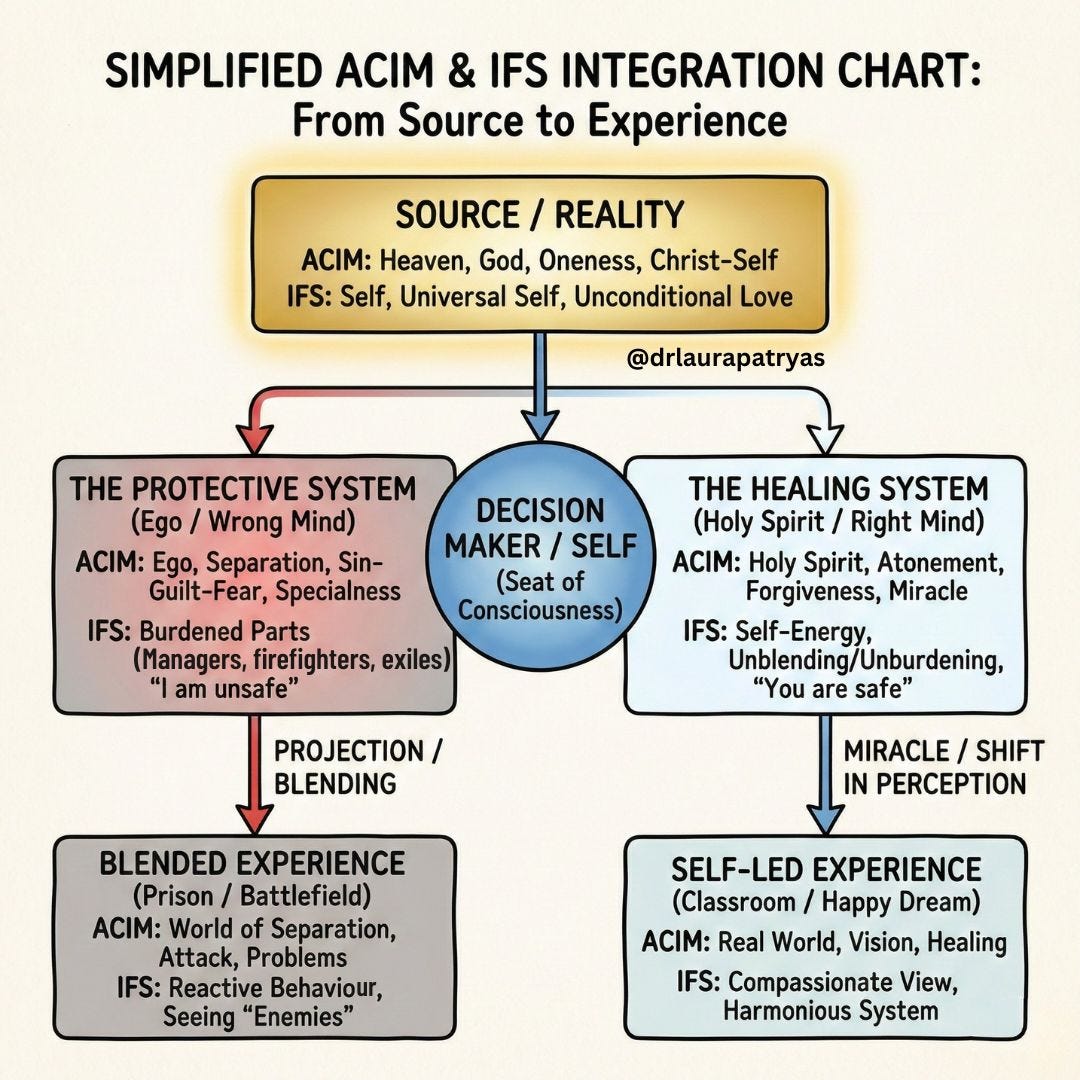
Ken Wapnick’s chart describes a mind that believes it’s separated from Source (love). This belief organizes the inner system around fear, resulting in a fearful experience of the world. In IFS language, this would be described as a protector-led system. Healing, therefore, is an inward journey rather than an attempt to fix the external world. It occurs at the level of choice, when Self becomes available and parts are no longer forced to carry the burden of keeping us safe on their own. ACIM calls this choosing the Holy Spirit; IFS calls it Self-leadership. In IFS, the lead trainer Cece Sykes also names Choice as the 9th C quality of Self. This capacity to choose closely parallels Kenneth Wapnick’s concept of the Decision Maker. In this way, both ACIM and IFS aim to restore our ability to choose between old patterns rooted in fear and new responses aligned with our inner wholeness. Inner wholeness is not the same as perfection, perfectionism is often a trauma response. The “real world” or “happy dream” is not a perfect life, but a nervous system and inner family that no longer believes it is alone. From there, perception softens, forgiveness becomes possible and life becomes a classroom rather than a prison.
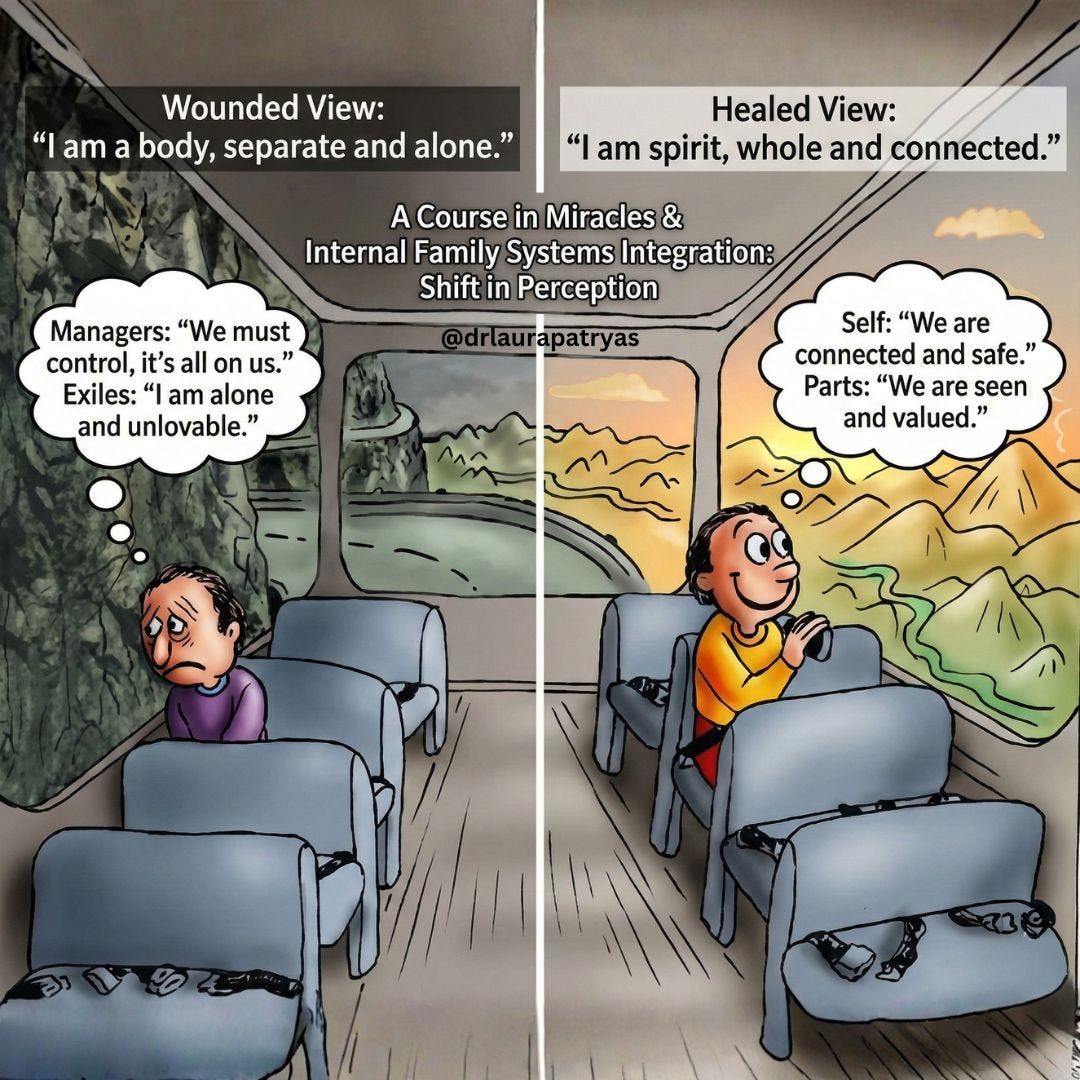
Through the lens of ACIM, essentially there is one mind. From it arises a belief in separation (ego), which produces a fearful inner system and a perceived world. Healing happens when Holy Spirit (Self) gently re-leads the system back into wholeness.
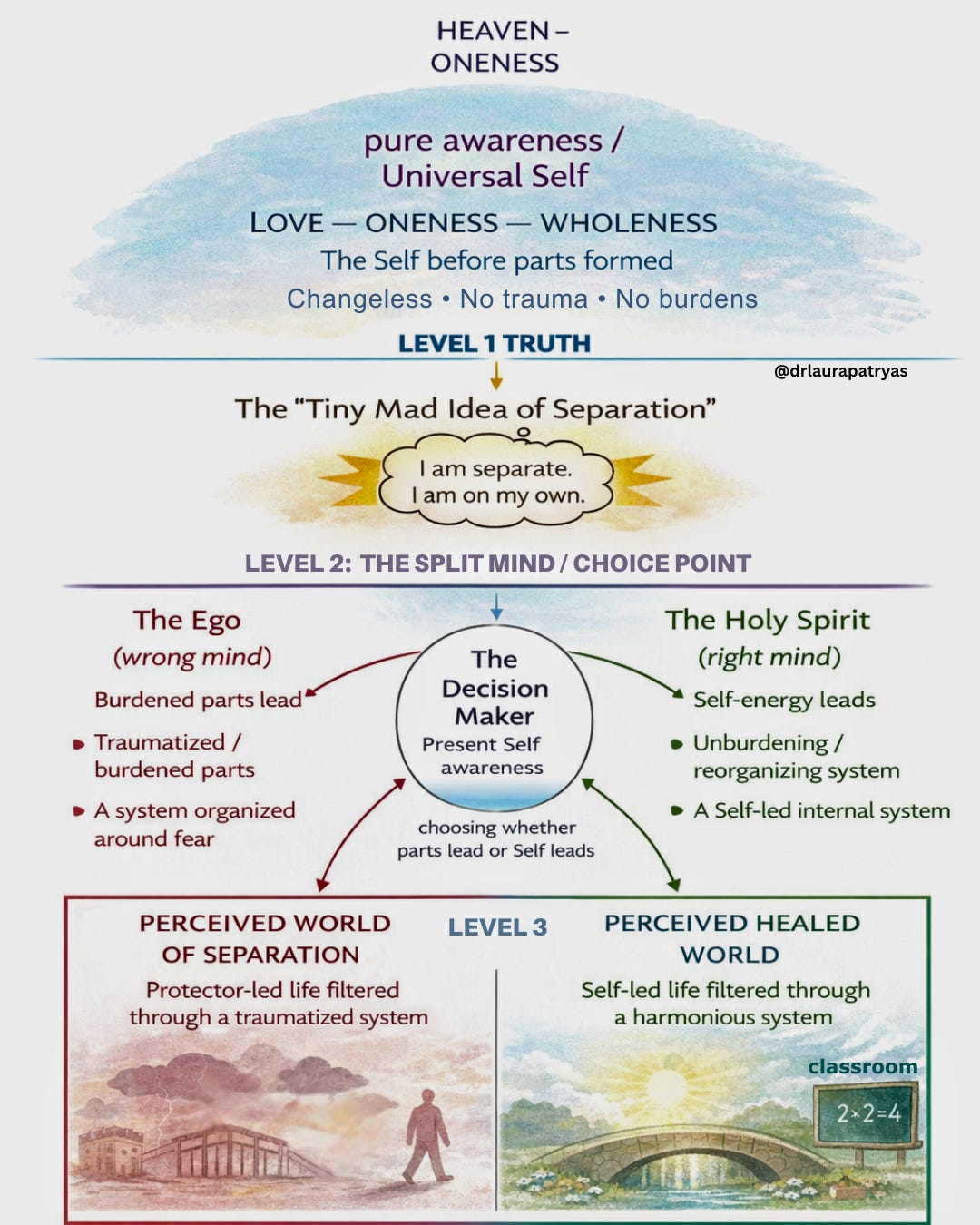
Broadly, the Course refers to three ‘levels’. There is no actual separation between them, but they appear distinct.
Level 1: The Source/Truth
ACIM: Heaven, Knowledge, God, Christ, Oneness, Love, Changelessness
IFS: Universal SELF, pure awareness, innate wholeness before fragmentation, the system before it ever had to organize for survival. This level is what Self already is and each part (even burdened parts) already have Self energy.
. . . . . . . . . . . . . . . . . . . . . . . . . . . . . . . .
The tiny mad idea (the pivot point)
ACIM: “The tiny mad idea”, the thought of separation, the split mind
IFS: The original rupture/misattunement, the moment the system believes in shame and worthlessness
. . . . . . . . . . . . . . . . . . . . . . . . . . . . . . . .
Level 2: The split mind (choice point)
- The Decision Maker (centre)
ACIM: Son of God as decision maker, chooses between ego or Holy Spirit
IFS: The Self (the Seat of Consciousness, “I”), observing and choosing presence, deciding how to respond when parts begin to blend, and redirecting toward harmony. If parts completely obscure the Self, experience becomes protector-led
This is where both therapy and ACIM actually operate. It is the realm of psychology, awareness and conscious choice.
- Left side: Ego (‘wrong mind’)
ACIM: Ego, projection, victimization, scarcity, “Ideas leave their source”
IFS: Burdened parts leading the system, protectors polarized and extreme, exiles carrying shame, fear, unworthiness, projection (parts externalizing threat), inner battlefield between parts (polarization), survival logic dominating, system organized around fear
- Right side: Holy Spirit (‘right mind’)
ACIM: Atonement, forgiveness, holy instant, real world, happy dream
IFS: Self-energy present, parts unblending, burdens releasing, system reorganizing around trust, compassion replacing control, increased harmony and flexibility, Self-led system
. . . . . . . . . . . . . . . . . . . . . . . . . . . . . . . .
Level 3: The world of form, perception and experience
ACIM: World of separation, time and space, body, problems and solutions, prison or classroom
IFS: External life reflecting the internal system, trauma reenactments or healing contexts, body as a messenger, not the enemy, life as either threat or opportunity depending on leadership (burdened parts versus Self)
This world is the result of the choice made in Level 2, leading to two apparent paths: Path A is the ego’s battlefield, path B is Holy Spirit’s classroom.
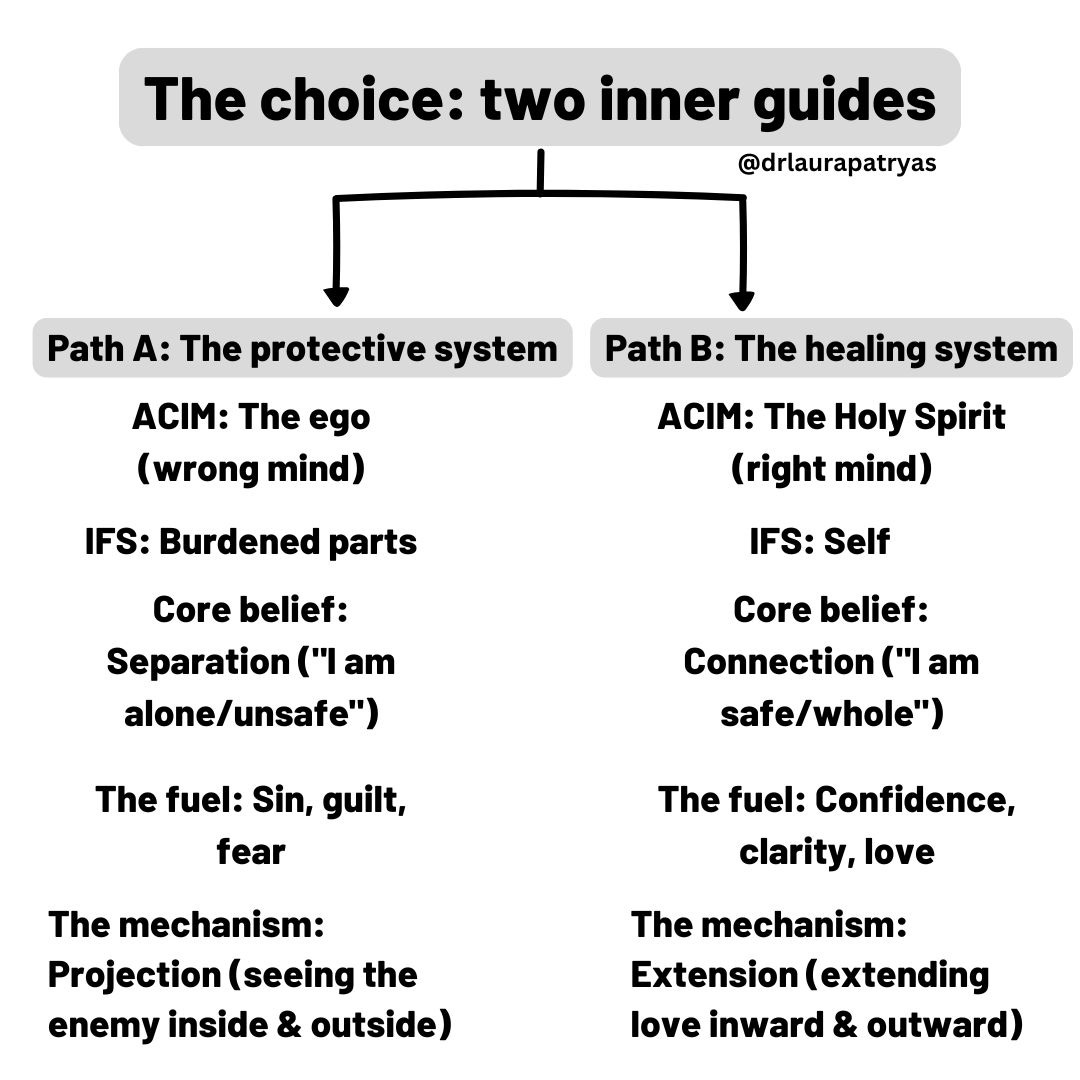
If your parts are finding all of this a little confusing or dense, the map below simplifies things further. The key point is Choice (Decision Maker). This is the observer (particle Self in IFS) that can guide the system toward Self-led wholeness or become obscured through blending with burdened parts, resulting in protector-led experiences.
I sincerely hope you found this post useful. If you have any questions, please don’t hesitate to leave them in the comments or email me. I wish you a most joyous and heart-opening ACIM/IFS journey.
If you feel called to support this work, you are invited to contribute to my GoFundMe page. Your donation acts as a bridge to sustain this spiritual offering. Please consider sharing this campaign - every gift extends peace, and in truth, the giver and receiver are one.
Namaste 🙏
What a beautiful read! :)
Another wonderful article which illuminates and inspires! Thx Dr. Laura!